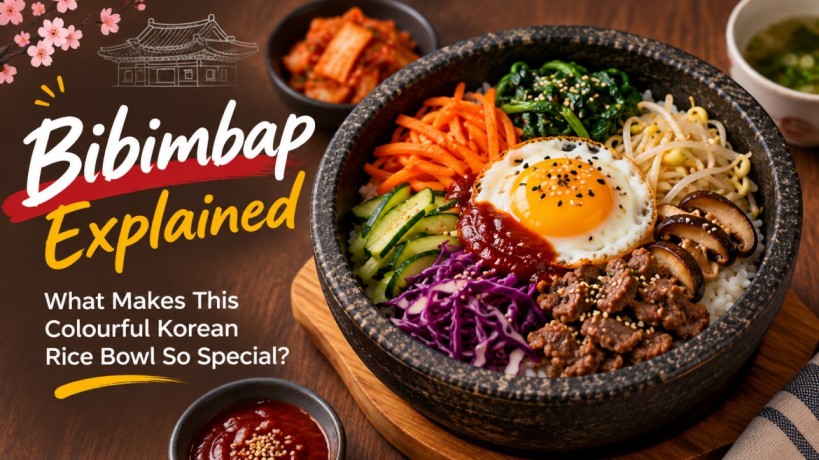
A bowl of rice may sound simple, but Korean Bibimbap turns it into one of Korea’s most colourful and recognisable meals. Neatly arranged vegetables, warm rice, Korean chilli paste, sesame flavours and optional protein come together in a dish that looks almost too organised to mix.
But mixing is exactly the point.
The word bibimbap literally refers to “mixed rice,” and the dish is designed so that the separate colours, textures and flavours come together before eating. Korea Tourism Organization describes bibimbap as rice served with different vegetables and other toppings, creating a combination of seasonal ingredients, colours and flavours.
For Indian diners discovering Korean food through K-dramas, K-pop or social media, Korean Bibimbap can also be one of the easiest dishes to understand. It feels familiar because rice forms the base, yet the vegetables, gochujang and Korean-style preparation create an experience that is distinctly Korean.
At Wang House Korean Street Food Café, bibimbap sits alongside Korean favourites such as ramen, tteokbokki, gimbap and mandu, giving diners another way to explore everyday K-food.
What Exactly Is Korean Bibimbap?
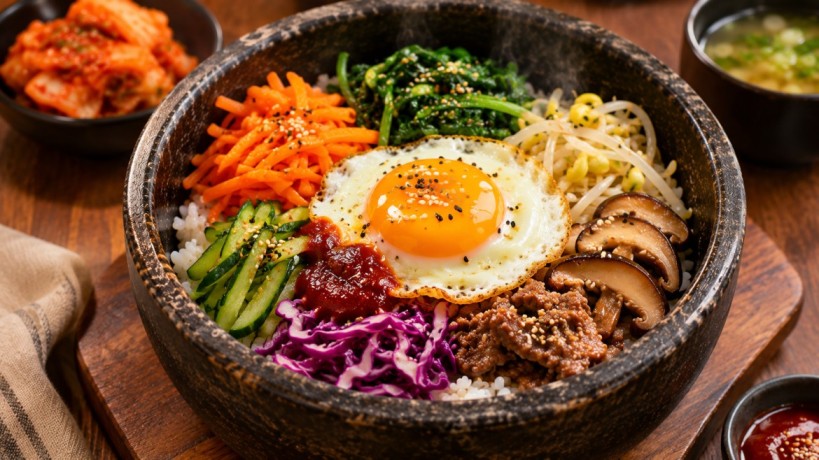
At its simplest, Korean Bibimbap is a rice bowl topped with individually prepared ingredients that are mixed together before eating.
Traditional versions can include spinach, bean sprouts, mushrooms, carrots or other seasonal vegetables, meat, egg, sesame oil and gochujang. The exact ingredients are not fixed, which is part of what makes the dish interesting.
The official VisitKorea description highlights vegetables such as bracken, spinach and bellflower along with rice and meat, while noting that different seasonal and local ingredients create different combinations.
That flexibility means bibimbap is not simply one recipe repeated everywhere.
Different homes, cities and restaurants can interpret the bowl differently while preserving its central idea: ingredients that may taste distinct individually are mixed into one complete dish.
Why Is Bibimbap So Colourful?
One of the first things people notice about bibimbap is its appearance.
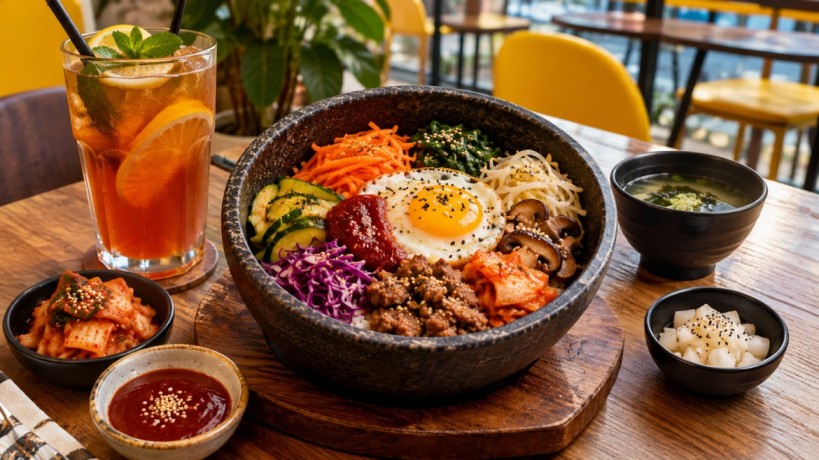
Before being mixed, the toppings are often arranged separately over the rice. Greens, orange vegetables, mushrooms, egg, meat and red chilli paste create clearly defined sections.
Traditional Korean food presentation often values colour as part of the eating experience. VisitKorea notes that bibimbap can feature the traditional colour spectrum of white, yellow, green, red and black, which helps explain why a well-prepared bowl looks so visually striking.
This colourful presentation has also made Korean Bibimbap particularly suited to modern food culture.
It photographs well, immediately communicates variety and gives first-time diners a clear look at what they are about to eat.
Then everything changes when you mix it.
Why Do You Mix Everything Together?
The carefully separated ingredients are not meant to remain separated.
The experience of bibimbap comes from combining them.
Rice carries the sauce. Vegetables bring different textures. Sesame oil adds aroma. Gochujang introduces sweetness, savouriness and chilli heat, while egg or meat can make the bowl richer.
Once mixed, every spoonful becomes slightly different.
That is what makes Korean Bibimbap interesting: the visual presentation celebrates the ingredients individually, while the actual eating experience celebrates how they work together.
For someone used to Indian rice bowls, pulao or rice-and-curry combinations, the concept can feel surprisingly intuitive even though the flavours are Korean.
What Is Gochujang’s Role in Bibimbap?
Gochujang is one of the ingredients most strongly associated with bibimbap.
It is a Korean fermented red chilli paste that can add chilli heat, sweetness, savouriness and depth.
Instead of simply making the dish “spicy,” it helps connect the rice and toppings.
The amount can also change the character of the bowl. Someone new to Korean food may prefer a lighter amount, while diners who enjoy stronger Korean flavours may mix in more.
This adaptability is useful when trying Korean Bibimbap for the first time because the bowl does not have to taste exactly the same for every diner.
Traditional Bibimbap vs Dolsot Bibimbap
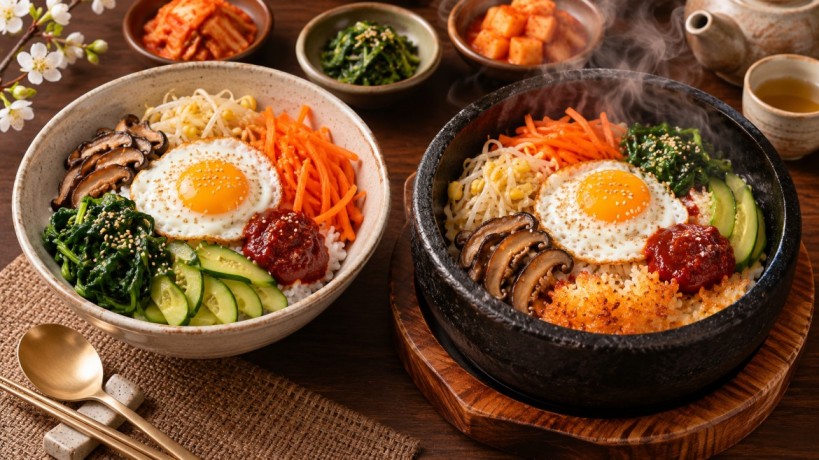
Another important variation is dolsot bibimbap.
“Dolsot” refers to the hot stone pot used to serve the dish. The pot keeps the food hot and can create a crisp layer of rice where it touches the heated surface.
VisitKorea describes hot stone pot bibimbap as rice served with colourful vegetables, beef, egg and red chilli paste in a stone pot that allows the dish to stay hot longer.
Regular bibimbap focuses more on the soft rice and mixed toppings, while dolsot bibimbap adds another textural element through that crispy rice.
Neither is automatically better. They simply create different experiences.
Why Jeonju Is Famous for Bibimbap
Bibimbap is eaten throughout Korea, but Jeonju is particularly famous for it.
VisitKorea describes Jeonju bibimbap as a colourful combination of rice, seasoned vegetables, egg, beef and other ingredients, with variations in the way the rice and toppings are prepared.
You can explore the regional background through VisitKorea’s guide to Jeonju Bibimbap.
This regional connection is important because it shows that bibimbap is not simply a modern social-media food trend. It is connected to Korea’s broader food traditions while still being adaptable enough to travel internationally.
Veg Bibimbap or Chicken Bibimbap?
One reason bibimbap works well for Indian diners is that the format adapts easily to different preferences.
At Wang House, the current Korean food menu includes both Veg Bibimbap and Chicken Bibimbap. The veg version combines sticky rice, vegetables and Korean red chilli paste, while the chicken version adds chicken and a fried egg.
For vegetarians, the rice-and-vegetable format offers an approachable introduction to Korean food.
For diners who prefer protein with their meal, chicken bibimbap provides a more filling variation while keeping the basic rice-bowl idea intact.
When ordering elsewhere, vegetarians should still check ingredients individually because traditional bibimbap can include meat or egg. VisitKorea similarly advises vegetarian travellers to confirm the ingredients when ordering bibimbap in Korea.
Korean Bibimbap in Delhi and Delhi NCR
Korean food has become much easier to explore in Delhi than it was a few years ago.
People searching for Korean Bibimbap in Delhi, Korean food in Delhi NCR or a Korean café near them no longer need to experience K-food only through videos and dramas.
Wang House currently lists two Delhi cafés: Laxmi Nagar in East Delhi and NSP, Pitampura in West Delhi.
You can check all current locations through the Wang House café locator.
That gives Korean-food fans on different sides of Delhi a practical place to explore bibimbap along with other street-food favourites.
Korean Bibimbap Near Laxmi Nagar, East Delhi
For diners around Laxmi Nagar, Nirman Vihar, Preet Vihar, East Delhi and nearby Delhi NCR areas, Wang House’s Laxmi Nagar café provides an accessible Korean-food stop.
The café is at H-25, Ground Floor, beside Sai Mandir, near Metro Pillar 34–35, Veer Savarkar Block, Laxmi Nagar, Delhi 110092. The official café page places it close to Laxmi Nagar Metro Gate 5.
Visitors who want to see how bibimbap fits with the rest of the menu can also read the Wang House guide to its Korean café menu in Laxmi Nagar.
For someone trying Korean cuisine for the first time, a rice dish such as bibimbap can be a comfortable starting point before moving on to stronger flavours such as kimchi ramen or tteokbokki.
Korean Bibimbap Near NSP and Pitampura
West Delhi has another useful option for people searching for Bibimbap near NSP, Pitampura or Netaji Subhash Place.
Wang House’s NSP café is located at G-53, Aggarwal Metro Heights, Netaji Subhash Place, Pitampura, New Delhi 110034. The official location information places it approximately 550 metres from the Netaji Subhash Place Pink Line exit.
That makes it convenient for diners around Pitampura, Rohini, Shalimar Bagh, Netaji Subhash Place and nearby West Delhi neighbourhoods who are exploring Korean food.
A bibimbap lunch or dinner can also work well for a casual café visit because it offers a complete rice-based meal without requiring diners to order several separate dishes.
Korean Bibimbap in Kochi, Kerala
The Korean-food experience is no longer limited to Delhi.
In Kerala, Wang House currently lists a café at Panampilly Nagar, Kochi, near Panampilly Nagar Central Park. The address shown by Wang House is KV Nagar, Panampilly Nagar, Kochi, Ernakulam, Kerala 682036.
For people searching for Korean Bibimbap in Kochi, Korean food in Ernakulam or a Korean café in Panampilly Nagar, this gives them a way to explore Korean dishes locally.
The popularity of rice-based food in Kerala can also make bibimbap an interesting cultural crossover. The preparation and seasoning are Korean, but the idea of building a satisfying meal around rice already feels familiar.
Korean Bibimbap in Calicut / Kozhikode
Wang House has also expanded the K-food experience to Calicut, Kerala, officially known as Kozhikode.
The current café listing places Wang House at Fourth Square Building, PT Usha Road, Calicut, Kerala 673032.
That makes the café particularly relevant for searches such as Korean food in Calicut, Korean café in Kozhikode, bibimbap in Calicut and K-food in Kerala.
For young diners, students, K-pop fans and K-drama audiences in Kozhikode, dishes such as bibimbap can provide a more direct way to experience Korean culture beyond the screen.
Why Bibimbap Works Well for First-Time Korean Food Explorers
Not everyone trying Korean food for the first time wants to begin with the hottest ramen or the strongest fermented flavours.
Korean Bibimbap can provide a gentler introduction.
The rice creates a familiar base. Vegetables add freshness and texture. Gochujang can usually be adjusted according to preference, and protein can vary.
After bibimbap, diners may feel more comfortable trying gimbap, mandu, Korean fried chicken, tteokbokki or ramen.
That progression is one reason Wang House positions itself as more than just a single-dish destination. Its broader story of bringing K-food into an Indian café environment is explained on the Wang House story page.
Bibimbap Is Also Part of the Wider Korean Lifestyle
Korean food has travelled internationally alongside K-pop, K-dramas, beauty, fashion and café culture.
A diner may first see bibimbap being eaten in a drama, then search for it online and eventually decide to try it locally.
That journey mirrors the wider growth of Korean lifestyle experiences in India.
For readers interested in the café side of this trend, Wang House also explores Seoul café culture and Korean café hopping, showing how food, design and social experiences increasingly overlap within contemporary Korean culture.
What Should You Eat With Bibimbap?
Bibimbap can comfortably work as a complete meal, but it can also become part of a larger Korean-food outing.
Mandu can add a dumpling starter. Mini gimbap works well for sharing. Korean fried chicken provides a contrasting crispy texture, while iced tea, boba or other café drinks can round out the meal.
If several friends are visiting together, ordering different dishes and sharing is also a useful way to explore more of the menu without everyone choosing the same thing.
Final Thoughts
Korean Bibimbap is special because it manages to be simple and detailed at the same time.
At its core, it is rice and toppings. But the careful arrangement of colours, individually prepared vegetables, Korean sauce, sesame flavours and the final act of mixing create something much more distinctive.
It also adapts easily.
Vegetarian or chicken, mild or spicy, traditional bowl or hot stone pot—the central idea remains the same: different ingredients coming together to create one meal.
For Korean-food fans in Delhi, Delhi NCR, Laxmi Nagar, NSP, Pitampura, Netaji Subhash Place, Kochi, Ernakulam, Calicut, Kozhikode and other parts of Kerala, bibimbap is becoming easier to discover without travelling to Korea.
And that may be the best way to understand the dish.
You can read about its colours and ingredients, but Korean Bibimbap really makes sense once you take that beautifully arranged bowl, mix everything together and taste how all those separate ingredients become one.