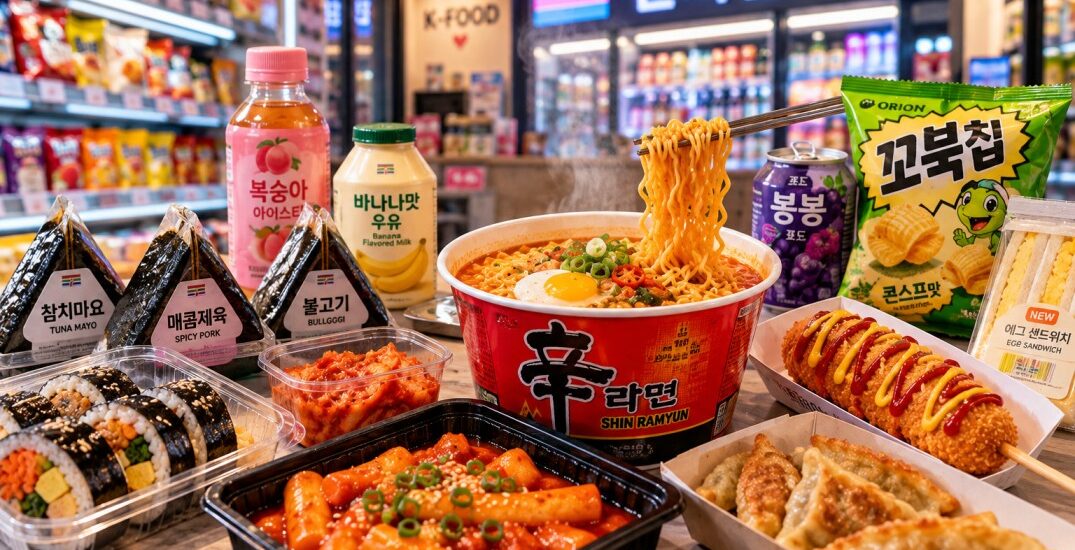
Korean convenience store food has become one of the most interesting everyday experiences connected with modern Korean culture. For many international K-culture fans, a convenience store in Seoul is no longer simply a place to grab water or a quick snack. It can be a place to choose ramyeon, prepare it on-site, combine snacks, heat a ready meal, grab a cold drink, and enjoy everything almost immediately.
If you watch K-dramas, Korean variety shows, travel vlogs, or mukbang videos, this experience may already look familiar. Characters stop at convenience stores after work, friends share noodles late at night, and creators experiment with unusual food combinations.
That visibility has helped turn an ordinary part of daily life into something international visitors actively want to experience. Visit Korea notes that convenience stores regularly appear in Korean dramas, movies, and TV shows, while their foods and new releases are particularly popular among younger consumers and tourists. Visit Korea
For Indian K-pop and K-drama fans, the appeal is easy to understand. It combines food, convenience, experimentation, and Korean pop culture in one accessible experience.
What Makes Korean Convenience Stores Different?
A convenience store is designed around speed and accessibility. However, in Korea, the food experience can go further than simply buying packaged products.
Many stores provide facilities that allow customers to prepare or heat food. Therefore, someone can buy cup noodles, a rice dish, dumplings, or another ready-to-eat item and enjoy it without going to a traditional restaurant.
Korea.net describes convenience stores as an important part of modern food life, offering products such as samgak gimbap, dosirak, cup noodles, gimbap, sandwiches, dumplings, chicken, and other quick foods. Many locations also provide hot water, microwaves, and simple seating. Korea.net
As a result, Korean convenience store culture combines shopping with a quick dining experience.
Moreover, this format fits busy lifestyles. Students can grab something between classes. Office workers can find a quick meal after work. Meanwhile, travellers can explore different Korean flavours without ordering a large restaurant meal.
Why Has This Food Culture Become Popular Worldwide?
The global rise of Korean entertainment has introduced international audiences to much more than music and television.
K-pop introduces fans to Korean fashion and lifestyle. K-dramas show everyday routines, restaurants, cafés, food deliveries, street-food stalls, and convenience stores. Meanwhile, YouTube, Instagram, and short-form video platforms make Korean eating experiences easy to discover.
Food becomes part of that cultural curiosity.
In fact, data cited by Korea.net from the Korea Tourism Organization showed strong growth in foreign spending on convenience-store food between 2018 and July 2025. The same report noted that food made up 40.1% of convenience-store-related online content analysed from 2023 through July 2025, with ramyeon, coffee, and snacks among prominent keywords. Korea.net
Therefore, the interest is not limited to traditional Korean cuisine. Everyday foods are increasingly part of how international visitors experience K-culture.
This is one reason Korean convenience store food works so well as cultural content: it feels accessible, casual, and easy to recreate.
The Role of K-Dramas and K-Pop in the Trend
Imagine a K-drama scene where two characters sit outside a convenience store late at night. They have cup noodles on the table, drinks beside them, and a quiet conversation after a difficult day.
The food is simple. However, the moment feels memorable.
Scenes like these can make everyday Korean routines interesting to international viewers. Moreover, K-pop idols and Korean entertainers frequently appear in food-related content, variety shows, livestreams, and behind-the-scenes videos.
Fans naturally become curious about what they are eating.
Therefore, Korean convenience store culture has become connected with the wider Korean Wave rather than existing only as a retail habit.
For Indian fans, trying the same style of noodles or snacks they have seen in Korean content can make K-culture feel a little closer.
Korean Instant Ramen: The Star of the Convenience Store Experience
Few foods represent this experience as clearly as Korean instant ramen.
Walk into a Korean convenience store and you may find shelves filled with different noodle varieties. Depending on the location, customers may also have access to hot water or cooking equipment.
This turns a packet or cup of noodles into an immediate meal.
Additionally, people often customise their noodles. Eggs, cheese, dumplings, rice cakes, kimchi, or other suitable toppings can create different combinations.
Korea.net notes that ramyeon can be prepared directly at convenience stores and describes combinations with ingredients such as kimchi, eggs, cheese, rice cakes, and mandu. Korea.net
For Indian food lovers, the appeal is particularly understandable because bold and spicy flavours are already familiar.
Meanwhile, Korean instant ramen is also highly social-media friendly. Steam rising from the noodles, melting cheese, colourful packaging, and the cooking process itself make excellent reel and vlog content.
Samgak Gimbap: A Small Meal with Big Convenience
Another item closely associated with Korean convenience stores is samgak gimbap.
It is a triangular rice-and-seaweed snack with a filling inside. Korea.net lists fillings such as tuna mayo, kimchi fried rice, bulgogi, Spam, and cheese among the varieties available in Korea. Korea.net
The clever packaging helps keep the seaweed separate from the rice until the package is opened.
Therefore, the seaweed can retain more of its texture.
For someone exploring Popular Korean convenience store food in Korea, samgak gimbap is useful to know because it represents what makes convenience-store dining appealing: it is compact, quick, filling, and available in many flavours.
Additionally, it can be paired with noodles for a more complete meal.
Dosirak and Ready-to-Eat Meals
Not every convenience-store visit has to revolve around noodles.
Dosirak, or packaged lunchboxes, can combine rice with several accompanying foods. These products are generally designed to be heated quickly, making them practical for people who need a warm meal without spending much time cooking.
Therefore, Korean convenience store meals can serve a different purpose from ordinary packaged snacks.
A person working late may want a warm rice meal. A student may need something filling during a busy day. Meanwhile, a traveller may simply want to experiment with an everyday Korean meal.
Korea.net identifies lunchboxes as a core convenience-store category and describes options built around rice and side dishes. Korea.net
This practical side is important because convenience-store dining is not just an internet trend. It also responds to real everyday needs.
Korean Convenience Store Snacks Worth Exploring
For many travellers and K-food fans, Korean convenience store snacks are where the experience becomes especially fun.
There can be sweet, salty, crispy, creamy, spicy, and unusual options. Moreover, limited releases and trending products can give shoppers something new to discover.
The snack aisle can also feel familiar to K-drama and K-pop fans who have seen similar products in Korean content.
However, there is no need to buy everything simply because it is trending. Instead, first-time visitors can choose a few different flavours and share them with friends.
That creates a tasting experience rather than just a shopping trip.
Additionally, Korean convenience store snacks pair naturally with cold beverages, coffee, ice cream, or a warm noodle meal.
The Famous “Convenience Store Combination” Trend
One of the most interesting parts of this food culture is combining separate products to create something new.
In Korea, such pairings are sometimes described as kkuljohap, literally suggesting a particularly good combination. Korea.net gives examples such as triangular gimbap with cup noodles, cheese with spicy noodles, and dumplings added to ramyeon. Korea.net
Therefore, a convenience-store meal does not always have to be eaten exactly as packaged.
This creates room for creativity.
For example, someone might combine spicy noodles with cheese to soften the heat. Another person might add dumplings to noodles for a more filling meal.
This experimentation has also become social content. People share combinations, review them, and create their own versions.
As a result, Korean convenience store food becomes participatory: people do not just consume it; they play with it.
Best Korean Convenience Store Food to Try for Beginners
If you are experiencing this style of food for the first time, you do not need a huge selection. Instead, choose items with different textures and flavours.
A balanced first experience could include:
- Cup ramyeon – for a warm and spicy noodle experience.
- Samgak gimbap – for a convenient rice-and-seaweed option.
- Dosirak – when you want a more complete rice-based meal.
- Mandu – Korean dumplings that can add a savoury side.
- Tteokbokki-style convenience food – for chewy rice cakes and a spicy-sweet profile.
- Korean chips or packaged snacks – for something crispy and shareable.
- Ice cream or dessert – useful after spicy food.
- Coffee or a chilled Korean beverage – to complete the convenience-store-style experience.
The Best Korean convenience store food to try ultimately depends on your taste. Someone who loves spice may start with noodles or tteokbokki, while someone who prefers milder flavours may enjoy rice dishes or snacks first.
Why Convenience Store Food Is Perfect for Social Media
K-food has a strong visual advantage.
Colourful noodle packets, triangular gimbap packaging, steaming ramyeon, cheese pulls, unusual drinks, ice cups, desserts, and snack shelves can all create visually interesting content.
At the same time, the preparation itself gives creators something to film.
A video can start with choosing Korean convenience store snacks, move to preparing noodles, show a creative combination, and finish with the first taste.
This format works naturally for short videos because there is a beginning, process, and reaction.
Moreover, convenience-store mukbang has become its own content category. Korea.net describes creators reviewing new products and showing creative combinations, while convenience-store dining has become connected with eating alone, late-night meals, and contemporary Korean lifestyles. Korea.net
Therefore, Korean convenience store culture is both an offline food experience and an online entertainment format.
From Everyday Food to Tourist Experience
A particularly interesting change is that something ordinary for local consumers can feel special to visitors.
A Korean student may enter a convenience store because they simply need dinner. However, an international tourist might enter because they have been waiting months to recreate a scene they saw online.
That difference shows the power of cultural exposure.
For example, Korea.net reported in 2024 on a specialised Ramyun Library in Seoul’s Hongdae area where visitors could choose from a large selection of noodles and prepare them using cooking machines. The report also described significant interest from foreign customers. Korea.net
Meanwhile, some convenience stores have expanded beyond food. Korea.net has reported themed locations incorporating entertainment, K-pop merchandise, technology, and other interactive elements. Korea.net
Therefore, Korean convenience store meals can now be part of a broader travel and cultural experience.
Popular Korean Convenience Store Food in Korea and What It Tells Us
Looking at Popular Korean convenience store food in Korea tells us something important about modern food habits.
People often want meals that are quick but still enjoyable. Additionally, they want variety. Someone might choose noodles today, a rice lunchbox tomorrow, and gimbap the next day.
Convenience stores respond to this by offering multiple categories in a relatively small space.
Meanwhile, Korean convenience store meals fit the lifestyles of people who study late, work irregular hours, travel, or live alone.
This also explains why the culture translates so well internationally.
The products may be Korean, but the basic need is universal: people want food that is convenient, satisfying, interesting, and easy to access.
From Korean Convenience Stores to the Korean Café Experience
A convenience store and a Korean café are different experiences. However, they share something important: both can make casual Korean food approachable.
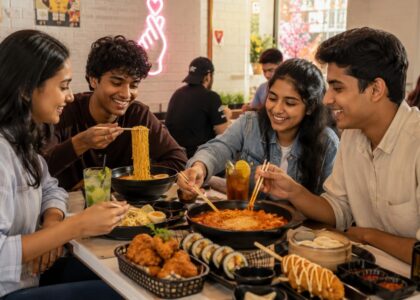
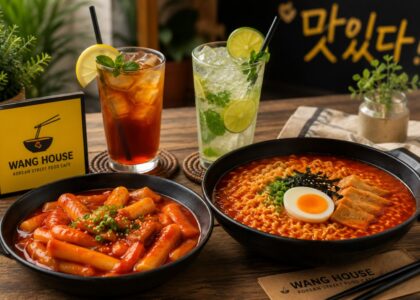
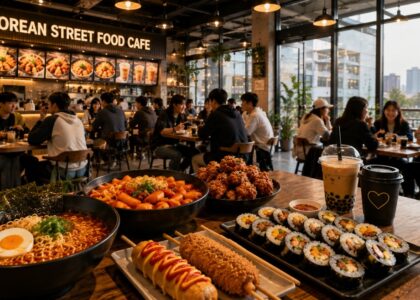
At a Korean street food café, friends might sit together over ramen, tteokbokki, rabokki, gimbap, mandu, Korean fried chicken, or cheese corn dogs.
The atmosphere is different, but the social idea remains familiar.
You order something exciting, share dishes, click photos, talk about your favourite K-drama or K-pop artist, and discover flavours together.
That is also where Wang House connects naturally with the wider K-food movement in India. The brand focuses on Korean-inspired street food, café experiences, and a youthful environment for people interested in Korean flavours and culture.
Readers beginning their K-food journey can explore the Wang House Korean food menu guide to learn about dishes they can try in a café setting.
Why Indian K-Food Fans Connect with the Trend
Indian and Korean cuisines are very different. However, there are certain flavour experiences that can make Korean food approachable for Indian diners.
Spicy sauces are one example. Warm noodle dishes are another. Additionally, crispy fried snacks, rice-based meals, dumplings, and cheesy foods can feel easy to explore even when the seasonings are new.
That makes Korean instant ramen an accessible starting point for many people curious about K-food.
Moreover, younger audiences increasingly discover food through entertainment and social media rather than traditional restaurant advertising alone.
Someone may see ramyeon in a drama tonight and search for Korean noodles tomorrow. Another person may watch a convenience-store reel and start looking for Korean snacks.
That relationship between entertainment, curiosity, and food discovery is an important part of modern K-culture.
For more Korean-inspired café experiences, readers can explore the Korean Café in Delhi guide.
How Korean Convenience Store Culture Connects with the Korean Wave
The Korean Wave, or Hallyu, has helped global audiences discover music, television, films, beauty, fashion, language, and food.
However, cultural curiosity does not stop with famous dishes.
People increasingly want to understand everyday experiences too.
What do Korean students eat between classes? What do people buy late at night? How is instant ramyeon prepared? What snacks are trending? What does a quick meal look like?
Those questions make ordinary food culturally interesting.
In 2026, the Oxford English Dictionary added “ramyeon” alongside several other Korean-origin terms, another indication of how Korean cultural vocabulary continues entering international awareness. Korea.net
Therefore, Korean convenience store culture offers international fans another window into contemporary Korean daily life.
Final Thoughts
Korean convenience store food has grown beyond its practical purpose and become part of the wider global fascination with K-culture. Ramyeon, samgak gimbap, dosirak, dumplings, desserts, drinks, and creative food combinations offer a casual way to experience everyday Korean flavours.
However, its appeal is about more than the products themselves.
It is about choosing your noodles from a colourful shelf, preparing a quick meal, experimenting with combinations, sharing snacks with friends, and recreating moments seen in K-dramas, travel videos, and Korean entertainment.
For Indian K-food fans, this creates another bridge between watching Korean culture and actually experiencing part of it through food.
And if that curiosity makes you want to go beyond packaged foods, a Korean street food café experience can introduce you to freshly prepared ramen, tteokbokki, rabokki, gimbap, mandu, corn dogs, fried chicken, and more.
Explore the Wang House home page for more about its Korean street food café experience.