At first glance, Ramyeon vs Ramen can sound like two spellings for the same bowl of noodles. Both are warm, comforting, wheat-based dishes associated with East Asian food culture, and both have become globally popular through restaurants, convenience stores, K-dramas, anime and social media.
However, when people discuss Ramyeon vs Ramen, they are usually talking about two noticeably different eating experiences. Ramyeon generally refers to Korea’s instant noodle culture, while ramen usually refers to the Japanese noodle dish prepared with noodles, carefully built broth and toppings.
The difference goes beyond spelling. Cooking style, flavour, noodles, broth, toppings and even the way people eat them can be different.
So, if you have ever wondered why Korean noodles often look fiery red while a Japanese ramen bowl may arrive with sliced meat, egg and a deeply flavoured broth, this guide explains it clearly.
What Is Korean Ramyeon?
In Korea, 라면 is commonly romanised as ramyeon. South Korea’s National Institute of Korean Language explains that “ramyeon” follows the official Romanisation system for the Korean word and can be useful when referring specifically to Korean-style instant noodles rather than Japanese ramen.
Korean ramyeon usually refers to instant noodles that come with seasoning powder, sauce or dried vegetables and can be prepared within minutes.
Korea Tourism Organization describes ramyeon as a common instant noodle dish served in snack bars and small eateries, often enhanced with ingredients such as egg, green onion, seafood or bean sprouts.
This convenience is a major part of the Ramyeon vs Ramen difference.
Ramyeon is closely associated with everyday Korean life. People cook it at home, prepare it in convenience stores, eat it late at night or add ingredients to turn one simple packet into a larger meal.
Korea.net also notes that popular combinations include kimchi, eggs, cheese, rice cakes and mandu.
What Is Japanese Ramen?
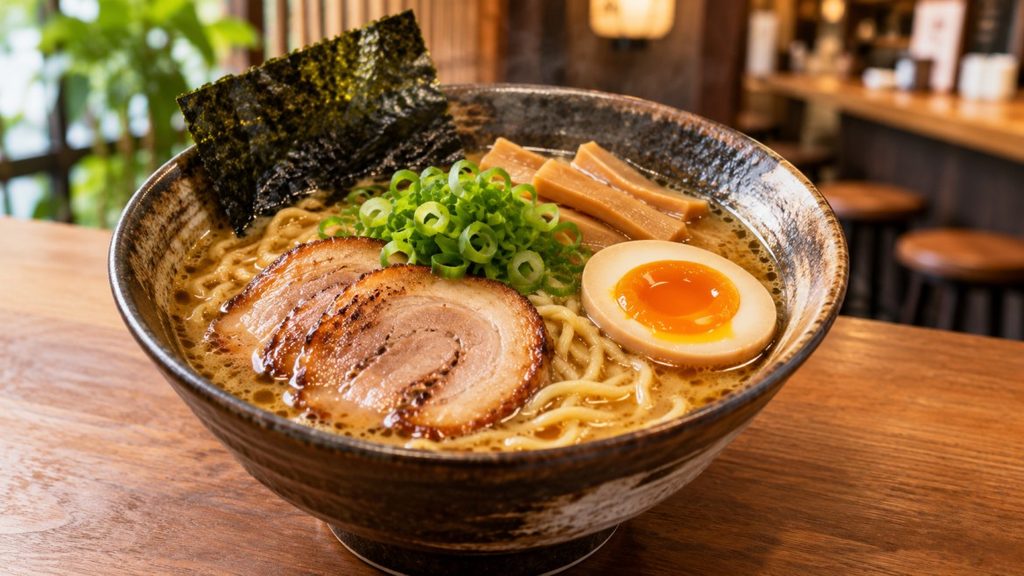
Japanese ramen is generally a prepared noodle dish built around noodles, broth, seasoning and toppings.
Japan’s official tourism organisation describes ramen as an inexpensive and casual meal found throughout the country, with significant regional variation. Common styles include shoyu, shio, miso and tonkotsu.
The noodles themselves are an important part of the dish.
Japan National Tourism Organization explains that ramen noodles commonly use kansui, an alkaline solution that gives them their characteristic texture and elasticity.
Broth can be created using pork, chicken, seafood and other ingredients before being combined with seasoning such as soy sauce, miso or salt.
Therefore, in the everyday Ramyeon vs Ramen comparison, Japanese ramen usually feels more like a composed restaurant dish, while Korean ramyeon is strongly associated with fast-cooking packaged noodles.
Ramyeon vs Ramen: The Main Differences
Here is the simplest way to understand the comparison:
| Feature | Korean Ramyeon | Japanese Ramen |
|---|---|---|
| Typical format | Instant noodles | Restaurant-style noodle dish |
| Preparation | Usually a few minutes | Often involves separately prepared broth and toppings |
| Flavour | Frequently spicy and bold | Wide variety from light to rich |
| Noodles | Usually dried instant noodles | Often fresh or prepared ramen noodles |
| Broth | Seasoning packet or sauce-based | Stock combined with tare/seasoning |
| Common toppings | Egg, kimchi, green onion, cheese, tteok | Chashu, egg, nori, bamboo shoots, green onion |
| Everyday setting | Home, snack shop, convenience store | Ramen shop or restaurant |
This table gives the practical difference between ramyeon and ramen, although the boundary is not absolute. Japan also produces instant ramen, while Korean restaurants can serve much more elaborate bowls.
The comparison describes how the terms are most commonly used rather than creating a strict culinary rule.
Difference 1: The Noodles
Noodle texture is one of the easiest things to notice in Ramyeon vs Ramen.
Many Korean instant noodles are dried into a curly block so that they can be stored and cooked quickly. Once placed in boiling water, they soften while usually retaining a springy, chewy texture.
Japanese ramen noodles can vary considerably.
They may be thin, thick, straight or curly depending on the style and region. For example, Japanese tourism sources describe Hakata ramen as being known for thin, straight noodles, while other regional varieties use different shapes and textures.
This noodle variation is one reason two Japanese ramen restaurants can offer completely different experiences.
Difference 2: The Broth
Broth creates another major Ramyeon vs Ramen distinction.
With ramyeon, the flavour generally comes from a seasoning sachet, sauce packet or combination included with the noodles.
Add boiling water, cook everything together and the soup develops quickly.
Japanese ramen usually takes a more layered approach.
Japan’s government describes ramen broth as combining stock or dashi with a concentrated seasoning called tare. Different combinations create flavours such as shoyu, miso and shio, while tonkotsu is characterised by a pork-bone-based stock.
This does not automatically make one better than the other.
They are designed for different experiences.
Ramyeon prioritises convenience and immediate flavour. Ramen can place greater emphasis on broth preparation and balance between multiple components.
Difference 3: Spicy vs Savoury
The Ramyeon vs Ramen comparison is often presented as spicy versus non-spicy, but that is an oversimplification.
Many popular Korean varieties do lean towards chilli, garlic and strong seasoning. Red, spicy broth has therefore become internationally associated with Korean noodles.
However, not every packet is extremely hot. Korea Tourism Organization notes that ramyeon comes in many flavours, including non-spicy varieties and different sauce-based options.
Japanese ramen also has enormous variety.
Shoyu ramen emphasises soy sauce, shio uses salt-based seasoning, miso provides deeper fermented flavour, and tonkotsu is known for its rich pork-bone soup.
Spicy Japanese ramen exists too.
So the better distinction is that Korean packets frequently build flavour around strong instant seasoning, while Japanese ramen restaurants often create flavour by combining stock, seasoning and aromatic components.
Difference 4: Toppings
Toppings make the Korean ramyeon vs Japanese ramen comparison visually obvious.
A basic Korean bowl can be enjoyed almost exactly as it comes from the packet.
But people frequently customise it.
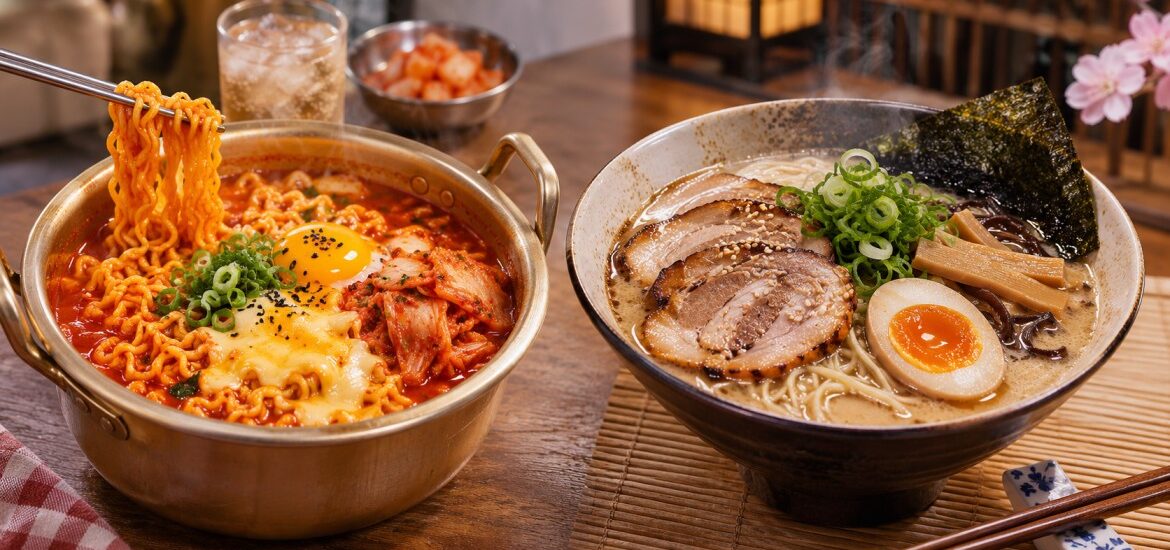
An egg can be cracked directly into the soup. Green onion adds freshness. Kimchi brings acidity and spice. Cheese creates creaminess. Tteok makes the bowl more filling, while mandu can turn it into a larger meal.
Ramen toppings can include sliced chashu pork, seasoned egg, bamboo shoots, nori, spring onion and other regional ingredients.
Japan’s Ministry of Agriculture describes Japanese ramen as a combination of soup, noodles and toppings, with ingredients and styles varying significantly across regions.
That presentation is part of the restaurant experience.
Difference 5: Cooking Time and Convenience
Speed is central to Ramyeon vs Ramen.
Ramyeon became popular partly because it could provide a convenient, affordable hot meal.
Korea.net traces the development of Korean ramyeon to the early 1960s, when instant noodles became suited to rapidly changing lifestyles.
Modern packets generally require little more than water, heat and a few minutes.
Restaurant ramen involves more components.
The stock, tare, aromatic oils, noodles and toppings may all be prepared separately before being assembled into the final bowl.
For customers, eating ramen can still be extremely quick—ramen shops in Japan are known for casual dining—but much of the preparation happens before the bowl reaches the table.
Why Do the Names Sound So Similar?
The spelling creates much of the Ramyeon vs Ramen confusion.
Korean 라면 is written as “ramyeon” under Korean Romanisation, while “ramen” is associated internationally with the Japanese dish.
The National Institute of Korean Language notes that the Korean term itself came from the Japanese word, but the foods referred to by the two terms today are not necessarily identical.
That historical relationship explains why the names sound related.
Over time, however, Korea developed a distinctive instant noodle culture of its own.
This is why writing “ramyeon” can be useful when discussing the Korean product specifically.
Ramyeon Culture in Korea
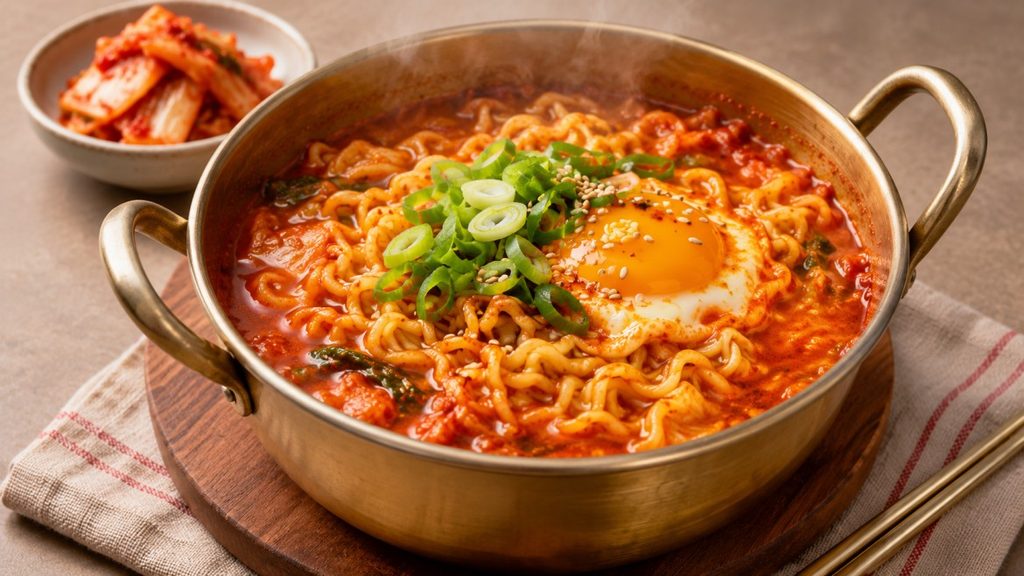
Understanding Ramyeon vs Ramen also means looking beyond recipes.
Ramyeon has become part of Korean everyday culture.
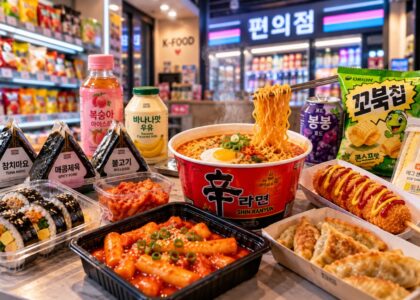
Convenience stores often provide hot-water facilities or cooking equipment so customers can prepare noodles immediately. People then customise them with eggs, cheese, sausages or other convenience-store ingredients.
K-dramas and variety programmes have made scenes of people eating noodles directly from a pot or convenience-store container familiar to international viewers.
That cultural visibility has helped Korean instant noodles travel far beyond Korea.
Japanese Ramen as a Regional Food Culture
Japanese ramen developed differently.
Instead of being dominated by one standard style, different regions created distinctive versions.
Hokkaido is associated with styles such as Sapporo miso ramen, Hakodate shio ramen and Asahikawa shoyu ramen. Japan’s Ministry of Agriculture notes that ramen shops and regional communities have continued developing their own flavours and local identities.
Fukuoka is particularly famous for Hakata-style tonkotsu ramen.
This regional diversity is an important part of the Korean ramyeon vs Japanese ramen discussion.
One represents a powerful instant-noodle culture, while the other is strongly connected with specialist shops and regional recipes.
Why Indian Korean-Food Fans Should Know the Difference
Korean food is becoming easier to discover in India through cafés, restaurants, supermarkets and cultural events.
Understanding Ramyeon vs Ramen helps customers know what type of bowl they are ordering instead of assuming every East Asian noodle soup will taste the same.
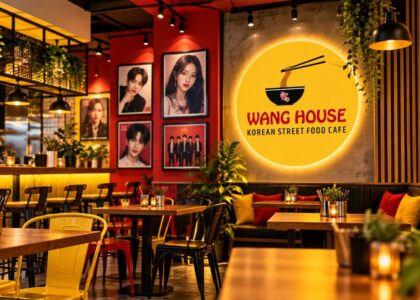
At Wang House, Korean-style soupy noodles can introduce customers to the bold, comforting flavour profile associated with modern Korean food culture.
For people who first discover Korean food through K-dramas or K-pop, ordering noodles can become one of the easiest ways to experience that culture beyond the screen.
Korean Culture Is Growing Offline in India Too
Interest in Korean food is growing alongside wider Korean pop culture.
Hello Korea is scheduled at KOPA Mall in Pune on 28–29 November 2026, featuring K-food, K-fashion, K-brands, K-drama and K-dance experiences.
Another major milestone will be Weverse Con Festival India, scheduled for 27–28 March 2027 at Yashobhoomi in New Delhi. Weverse’s official announcement lists artists including ENHYPEN, TOMORROW X TOGETHER, LE SSERAFIM, Hwasa and Eric Nam, among others.
BookMyShow currently lists the festival as sold out, showing the scale of interest surrounding Korean pop culture in India.
Food naturally becomes part of this cultural curiosity.
Someone may discover Korea through music, become interested in dramas and eventually start exploring dishes such as tteokbokki, gimbap, mandu and ramyeon.
Which One Should You Try?
There is no winner in Ramyeon vs Ramen.
Choose ramyeon when you want something fast, comforting, customisable and often strongly seasoned.
Choose Japanese ramen when you want to explore different broths, noodle textures, toppings and regional styles.
Better still, try both.
They may share related names and noodle roots, but they represent different culinary traditions and different ways of enjoying a bowl of noodles.
Final Thoughts
The easiest way to remember Ramyeon vs Ramen is this: ramyeon usually refers to Korea’s instant-noodle culture, while ramen usually refers to Japan’s prepared noodle-and-broth tradition.
But the real difference between ramyeon and ramen is more interesting than a simple instant-versus-fresh comparison.
It includes flavour, broth, noodle texture, toppings, preparation and the cultural setting in which each dish developed.
As Korean and Japanese food continue reaching more Indian diners, understanding these differences makes exploring both cuisines more enjoyable.
At first glance, Ramyeon vs Ramen can sound like two spellings for the same bowl of noodles. Both are warm, comforting, wheat-based dishes associated with East Asian food culture, and both have become globally popular through restaurants, convenience stores, K-dramas, anime and social media.
However, when people discuss Ramyeon vs Ramen, they are usually talking about two noticeably different eating experiences. Ramyeon generally refers to Korea’s instant noodle culture, while ramen usually refers to the Japanese noodle dish prepared with noodles, carefully built broth and toppings.
The difference goes beyond spelling. Cooking style, flavour, noodles, broth, toppings and even the way people eat them can be different.
For Indian diners who want to explore Korean food beyond what they see in K-dramas, cafés such as Wang House Korean Street Food Café make Korean-style noodles and street-food favourites easier to experience in a casual café environment.
What Is Korean Ramyeon?
In Korea, 라면 is commonly romanised as ramyeon. The National Institute of Korean Language explains that, under Korean Romanisation, 라면 can be written as “ramyeon”, and the spelling is particularly useful when referring to Korean-style instant noodles rather than the Japanese dish.
Korean ramyeon usually refers to instant noodles that come with seasoning powder, sauce or dried vegetables and can be prepared within minutes.
Ramyeon is closely associated with everyday Korean life. People cook it at home, prepare it in convenience stores, eat it late at night or add ingredients to transform one simple packet into a larger meal.
Egg, green onion, kimchi, cheese, rice cakes, dumplings and even slices of meat can completely change the character of a basic bowl.
This convenience and customisation are major parts of the Ramyeon vs Ramen difference.
What Is Japanese Ramen?
Japanese ramen is generally a prepared noodle dish built around noodles, broth, seasoning and toppings.
According to the official Japan National Tourism Organization ramen guide, ramen is found throughout Japan and includes major styles such as shio, shoyu, miso and tonkotsu.
The noodles themselves are an important part of the dish. Japanese ramen noodles can vary in thickness, shape, firmness and texture depending on the region and ramen style.
Broth may be created using pork, chicken, seafood or vegetables before being combined with seasonings such as soy sauce, miso or salt.
Therefore, in the everyday Ramyeon vs Ramen comparison, Japanese ramen usually feels more like a composed restaurant dish, while Korean ramyeon is strongly associated with fast-cooking packaged noodles.
Ramyeon vs Ramen: The Main Differences
Here is the simplest way to understand the comparison:
| Feature | Korean Ramyeon | Japanese Ramen |
|---|---|---|
| Typical format | Instant noodles | Restaurant-style noodle dish |
| Preparation | Usually a few minutes | Often involves separately prepared broth and toppings |
| Flavour | Frequently spicy and bold | Wide variety from light to rich |
| Noodles | Usually dried instant noodles | Often fresh or prepared ramen noodles |
| Broth | Seasoning packet or sauce-based | Stock combined with seasoning |
| Common toppings | Egg, kimchi, green onion, cheese, tteok | Chashu, egg, nori, bamboo shoots, green onion |
| Everyday setting | Home, snack shop, convenience store | Ramen shop or restaurant |
This table gives the practical difference between ramyeon and ramen, although the boundary is not absolute. Japan also produces instant ramen, while Korean restaurants and cafés can serve more elaborate Korean-style noodle bowls.
Difference 1: The Noodles
Noodle texture is one of the easiest things to notice in Ramyeon vs Ramen.
Many Korean instant noodles are dried into curly blocks so they can be stored for long periods and prepared quickly. Once added to boiling water, they soften while usually maintaining a springy and chewy texture.
Japanese ramen noodles can vary considerably.
They may be thin, thick, straight or curly depending on the region and style. Hakata-style ramen, for example, is famous for thin noodles, while other Japanese ramen styles use thicker or more elastic noodles.
This variation is one reason two Japanese ramen restaurants can provide completely different noodle experiences.
Difference 2: The Broth
Broth creates another major Ramyeon vs Ramen distinction.
With ramyeon, flavour generally comes from seasoning powder, sauce packets or dried ingredients provided with the noodles.
Add boiling water, cook everything together and a strongly flavoured soup can develop within minutes.
Japanese ramen usually takes a more layered approach.
Stock, tare or concentrated seasoning, aromatic oils and other components can be prepared separately and then combined before serving.
This does not automatically make one better than the other. They are designed for different experiences.
Ramyeon prioritises convenience, bold flavour and easy customisation. Ramen can place greater emphasis on broth preparation and balance between several carefully prepared components.
Difference 3: Spicy vs Savoury
The Ramyeon vs Ramen comparison is often presented as spicy versus non-spicy, but that is an oversimplification.
Many popular Korean noodle varieties lean towards chilli, garlic and strong seasoning. Red, spicy soup has therefore become internationally associated with Korean noodles.
However, not every Korean noodle bowl needs to be extremely hot.
At Wang House, customers interested in exploring this Korean-style noodle experience can check the Wang House Korean food menu, which includes soupy noodle options alongside tteokbokki, rabokki, gimbap, mandu and other Korean street-food favourites.
Japanese ramen also has enormous variety.
Shoyu ramen emphasises soy sauce, shio uses salt-based seasoning, miso creates a deeper fermented flavour and tonkotsu is famous for its rich pork-bone soup.
So the better distinction is that Korean instant noodles frequently build flavour around powerful seasoning, while Japanese ramen restaurants often create flavour by combining stock, tare and aromatic components.
Difference 4: Toppings
Toppings make the Korean ramyeon vs Japanese ramen comparison visually obvious.
A basic Korean bowl can be eaten almost exactly as it comes from the packet, but people frequently personalise it.
An egg can be cracked directly into the soup. Green onions add freshness. Kimchi provides acidity and spice. Cheese creates creaminess. Tteok adds a chewy texture, while mandu can transform a simple bowl into a more filling meal.
This customisable approach is one reason Korean noodles work particularly well as comfort food.
Japanese ramen toppings commonly include sliced chashu, seasoned egg, bamboo shoots, nori and spring onions.
Presentation therefore becomes another important part of the ramen-shop experience.
Difference 5: Cooking Time and Convenience
Speed is central to Ramyeon vs Ramen.
Ramyeon became popular partly because it could provide a convenient hot meal without complicated preparation.
Modern packets generally require little more than water, heat and a few minutes.
Restaurant ramen involves more components. Stock, seasoning, noodles, aromatic oils and toppings may all be prepared separately before the final bowl is assembled.
For the customer, eating ramen can still be a quick experience, but considerably more preparation may happen before the bowl reaches the table.
Why Do the Names Sound So Similar?
The spelling creates much of the Ramyeon vs Ramen confusion.
Korean 라면 is commonly written as “ramyeon”, while “ramen” has become internationally associated with the Japanese noodle dish.
The words share historical connections, but modern Korean ramyeon culture evolved into something distinctive of its own.
That is why using “ramyeon” can be helpful when specifically discussing Korean instant noodles.
Ramyeon Culture in Korea
Understanding Ramyeon vs Ramen also means looking beyond recipes.
Ramyeon has become part of everyday Korean culture.
Convenience stores can provide hot water or cooking facilities so customers can prepare noodles immediately and add ingredients such as eggs, cheese, sausages and other snacks.
If you are interested in this side of Korean lifestyle, Wang House’s guide to Korean convenience store food and K-culture explores how ramyeon, convenience-store snacks and quick Korean meals have become part of the global Korean Wave.
K-dramas and variety programmes have also made scenes of people eating noodles directly from a pot or convenience-store container familiar to international audiences.
That visibility has helped Korean instant noodles travel far beyond Korea.
Japanese Ramen as a Regional Food Culture
Japanese ramen developed differently.
Instead of being dominated by one standard style, different regions created distinctive versions.
Hokkaido is associated with varieties such as Sapporo miso ramen, Hakodate shio ramen and Asahikawa shoyu ramen.
Fukuoka, meanwhile, is particularly famous for Hakata-style tonkotsu ramen.
This regional diversity is an important part of the Korean ramyeon vs Japanese ramen discussion.
One represents a powerful instant-noodle culture, while the other is strongly connected with specialist noodle shops and regional recipes.
Korean Food Is More Than Just Ramyeon
For many international fans, ramyeon becomes one of the first introductions to Korean cuisine.
But once you start exploring, the food culture extends much further.
Tteokbokki introduces chewy rice cakes and spicy sauce. Gimbap offers rice and fillings wrapped in seaweed. Mandu introduces Korean-style dumplings, while bibimbap combines rice, vegetables, sauces and protein in one bowl.
At Wang House, the idea is to let customers move beyond seeing these dishes on a K-drama screen and actually experience Korean street food themselves.
Visitors who want to plan a Korean-food outing can explore the Wang House café locations and choose a convenient café for their next meal with friends.
A bowl of noodles might be the starting point, but discovering Korean food can quickly become a much broader cultural experience.
Why Indian Korean-Food Fans Should Know the Difference
Korean food is becoming easier to discover in India through cafés, restaurants, supermarkets, cultural festivals and social media.
Understanding Ramyeon vs Ramen helps customers know what kind of noodle experience they are ordering instead of assuming that every East Asian noodle soup is the same.
At Wang House, Korean-style soupy noodles introduce customers to the comforting, bold flavour profile associated with contemporary Korean food culture.
The café experience can also make these foods more approachable. Someone trying Korean food for the first time can start with noodles and then explore dishes such as gimbap, mandu, tteokbokki, bibimbap or Korean fried chicken.
From K-Dramas to Korean Café Culture
Food is only one part of the Korean Wave.
Many people who become interested in Korea through K-pop or K-dramas eventually become curious about Korean fashion, beauty, convenience stores, cafés and everyday lifestyles.
That makes cafés particularly interesting cultural spaces.
Our article about Seoul café culture and café hopping explores how Korean cafés have become places for food, coffee, socialising, studying and lifestyle experiences.
For Indian customers, a Korean café can provide a small taste of that environment without needing to travel to Seoul.
Korean Culture Is Growing Offline in India Too
Interest in Korean food is growing alongside wider Korean popular culture.
Events, screenings and fan gatherings give people opportunities to experience Korean culture together instead of only following it online.
This relationship between fandom, cafés and Korean culture is explored further in our guide to K-pop fan events in India and Korean café culture.
For Wang House, these cultural connections are important because a Korean café can become more than somewhere to quickly eat. It can also become a meeting point where friends enjoy Korean food, talk about their favourite K-dramas or K-pop artists, and discover new parts of Korean culture together.
That is the type of experience Wang House aims to create: Korean flavours, a relaxed café environment and a place where curiosity about Korea can turn into a real food experience.
Which One Should You Try?
There is no winner in Ramyeon vs Ramen.
Choose ramyeon when you want something fast, comforting, customisable and often strongly seasoned.
Choose Japanese ramen when you want to explore different broths, noodle textures, toppings and regional styles.
Better still, try both.
They may share related names and noodle roots, but they represent different culinary traditions and different ways of enjoying a bowl of noodles.
And if Korean-style noodles are what you are craving, Wang House gives you a place to start your K-food journey with a hot bowl before exploring the rest of Korea’s street-food favourites.
Final Thoughts
The easiest way to remember Ramyeon vs Ramen is this: ramyeon usually refers to Korea’s instant-noodle culture, while ramen usually refers to Japan’s prepared noodle-and-broth tradition.
But the real difference between ramyeon and ramen is more interesting than a simple instant-versus-fresh comparison.
It includes flavour, broth, noodle texture, toppings, preparation and the cultural setting in which each dish developed.
As Korean and Japanese food continue reaching more Indian diners, understanding these differences makes exploring both cuisines more enjoyable.
For Korean-food fans, the next step does not have to stop with reading about the difference. Visit Wang House with friends, try a Korean-style noodle bowl and explore other dishes that bring a little more K-food culture into your day.
Ultimately, Ramyeon vs Ramen is not about deciding which country makes the better noodles. It is about recognising that two similar-sounding names can lead to two very different—and equally interesting—bowls.